
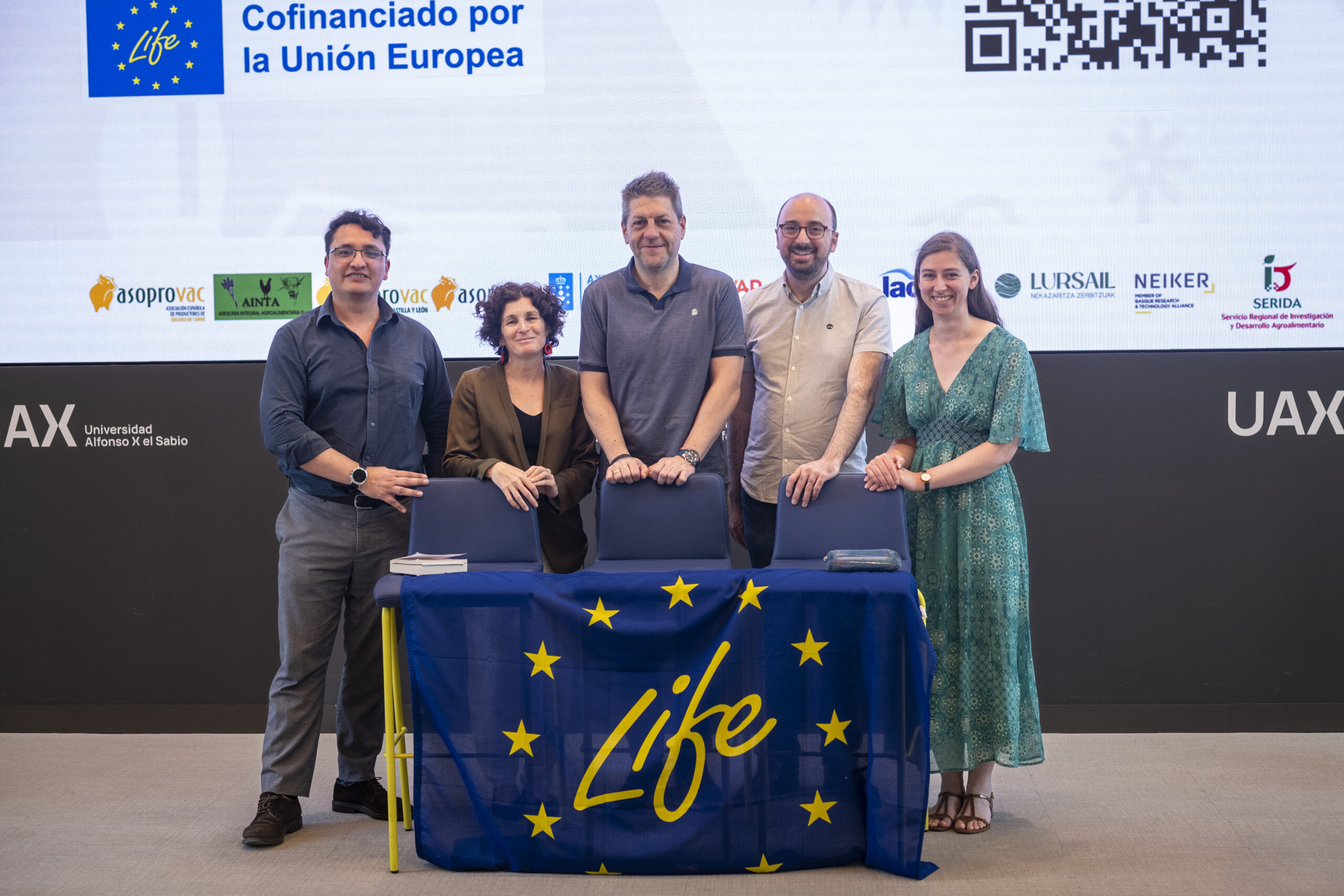

- The event showcased the results of the LIFE Carbon Farming project in Spain, including the country’s first carbon projects developed from work carried out on 122 beef and dairy farms.
- Representatives from the OECD, the French Label Bas Carbone scheme, public authorities, universities and research centers discussed the role of national data and farmers in the development of agricultural decarbonization initiatives.
Madrid, 22 June 2026 – On 18 June, the UAX Campus in Chamberí hosted a conference dedicated to presenting the carbon projects developed within the framework of the LIFE Carbon Farming project on Spanish beef and dairy farms. The event brought together representatives from public administrations, research institutions, academia, companies and farmers to discuss the challenges and opportunities associated with reducing emissions in livestock production.
The conference was opened by Matilde Moro, Managing Director of ASOPROVAC, who outlined the significant effort and precision work undertaken to support farmers throughout the project. Moro highlighted the evolution of the carbon footprint calculation tool used, which has benefited from ten years of continuous improvement, and expressed her gratitude to the participating farmers and partner companies whose voluntary collaboration has been essential to improving measurement systems and identifying new opportunities for optimization within the sector.
The keynote presentation was delivered by Koen Deconinck, Economist and Policy Analyst at the OECD, who examined the differences in environmental impacts across agri-food products and the growing demand for environmental information throughout the value chain. During his presentation, he explained global trends in allocating product impacts across different scopes and supply chain actors. He also analyzed the current proliferation of environmental assessment tools and stressed the importance of using national data to ensure the robustness and comparability of environmental evaluation systems.
Following this, Anaïs L’Hôte presented the experience of the French Label Bas Carbone, one of Europe’s leading frameworks for developing agricultural emission reduction projects. The representative from IDELE provided insights into the approximate market value of French carbon credits and the profile of companies currently investing in agricultural decarbonization initiatives.
Among the strengths of the French model, L’Hôte highlighted the high level of farmer engagement, reflected in the fact that only 7% of participants withdrew before project completion. She also emphasized the strong technical efficiency achieved through the involvement of advisors and field organizations, which enabled final audits to be completed strictly within the planned timeframe. Furthermore, she underlined the robustness of the certification process, ensuring the proper use of monitoring tools and guaranteeing fair remuneration for participants.
The second part of the conference focused on practical implementation in Spain. Óscar del Hierro, researcher at Neiker, explained the operation of BOVID CO2, a key component of the project. Del Hierro highlighted the capabilities of this tool, which has been specifically developed using national emission factors and databases. In particular, he referred to the inclusion of an innovative feed calculator as one of BOVID CO2’s most significant contributions. This development has been made possible through close collaboration with cooperatives and feed companies and opens new opportunities to optimize feeding strategies, one of the most important areas with the greatest potential for improvement in reducing emissions.
For his part, Roberto Jiménez, technician at ASOPROVAC and Technical Coordinator of the LIFE Carbon Farming project in Spain, presented the carbon projects developed through the initiative. These projects implement emission reduction and carbon sequestration measures with the aim of certifying the results achieved, potentially generating marketable carbon credits. Jiménez presented the evolution of carbon footprints throughout the project in participating farms, resulting from the implementation of mitigation measures identified across different production systems. His presentation concluded with the results obtained from the carbon projects derived from this extensive technical advisory and monitoring work.
Following the screening of a video illustrating the day-to-day implementation of the project on a participating farm in Segovia, the event was officially closed by Isabel Rodríguez Hurtado, Dean of Veterinary Sciences at UAX, and Ana Díaz Pérez, Deputy Director for Food Quality and Sustainability at the Spanish Ministry of Agriculture, Fisheries and Food.
Rodríguez Hurtado strongly emphasized the crucial role of veterinarians as key actors and guides in the ecological transition of the primary sector. Meanwhile, Ana Díaz Pérez concluded by stating that sustainable production systems must be built hand in hand with farmers, highlighting that this transition represents a major opportunity for the future of the sector.
The success and robustness of the project in Spain are the result of the joint efforts of a strong multidisciplinary consortium. Coordinated by ASOPROVAC Nacional, the Spanish consortium of the LIFE Carbon Farming project brings together leading organizations from across the livestock production, technical, scientific and business sectors: Agacal, COVAP, SERIDA, Lursail, Lactiber, ASOPROVAC Castilla y León, ASOPROVAC Cataluña, AINTA, Neiker and Global Factor.
Together, these organizations are contributing to the development of practical and credible carbon farming solutions for the Spanish livestock sector within the broader European LIFE Carbon Farming initiative.
 This project is co-funded by the LIFE Programs of the European Commission


